_1786009245523-BvnNmDYr.png)
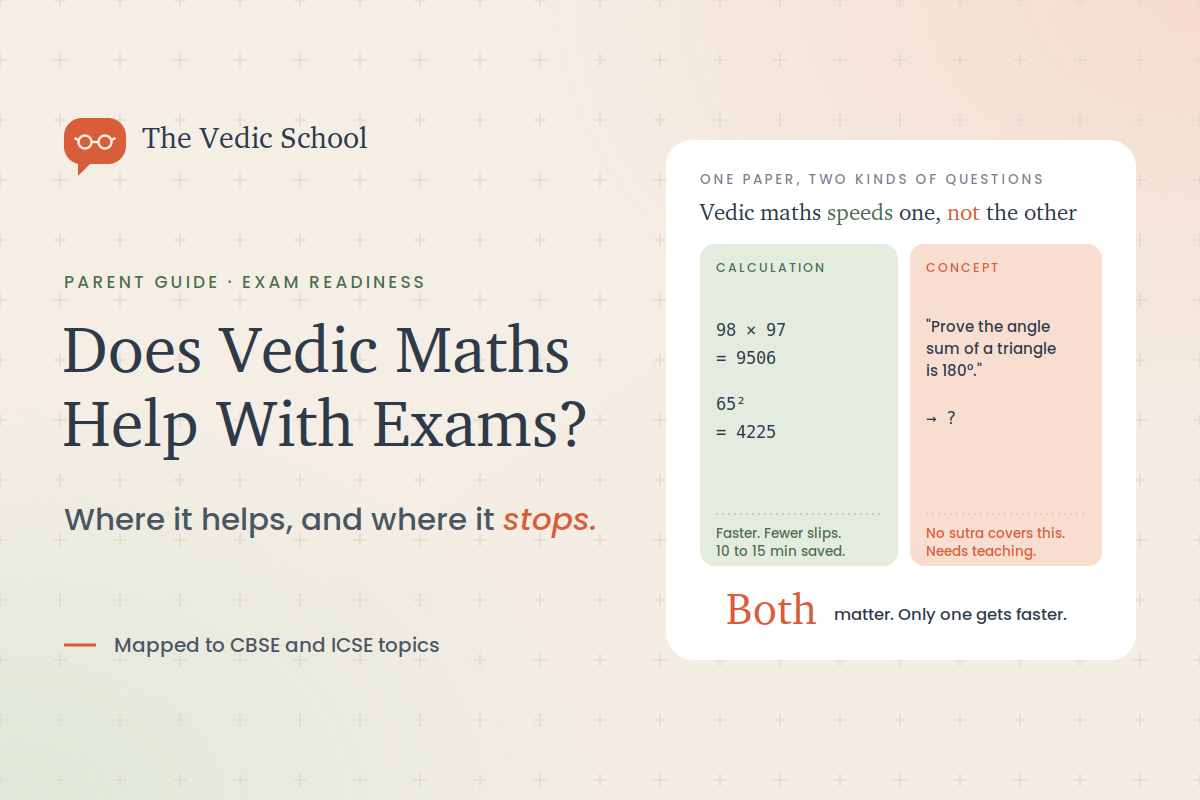
Vedic maths makes arithmetic faster and more accurate, helping child do sums faster.
It helps most in Class 4 to Class 10, where papers are computation-heavy (fractions, percentages, interest, mensuration).
Biggest exam gains: 10 to 15 minutes saved per paper, fewer careless errors, and a fast checking routine using digit sums.
Vedic math does not replace written working. Students should compute mentally, then show the standard method to secure step marks.
Vedic techniques map neatly to specific CBSE and ICSE topics (squares, multiplication, percentages, algebraic identities) but not to geometry proofs, statistics, graphs or word problems.
By Class 11 and 12, arithmetic speed is no longer the bottleneck, so returns drop.
A good programme follows the school calendar and teaches techniques alongside the chapter being studied that month.
If the child understands maths but loses marks on time, add Vedic maths. If the child does not understand the concepts, fix that first.
Quick verdict: Vedic maths helps with school exams in one specific way: it makes calculation faster and more accurate, which saves time and cuts careless errors in Classes 4 to 10. It does not teach concepts and does not replace the school syllabus. It works best as an add-on to regular maths, not a substitute for it.
Most parents who ask The Vedic School this question have already tried something. A coaching centre, a maths app, a relative who was good at numbers. The child still freezes in the exam, runs out of time, or makes careless mistakes in sums they know how to do. So the scepticism is fair. Vedic maths gets sold as magic, and magic is not what a Class 7 student needs before a half-yearly.
Let us be precise instead.
What Vedic maths is, in one paragraph
Vedic maths is a set of 16 sutras (short rules) and 13 sub-sutras for mental calculation, compiled by Bharati Krishna Tirtha and published in the 1965 book Vedic Mathematics. Each sutra is a shortcut for a specific type of sum: multiplying numbers close to 100, squaring numbers ending in 5, dividing by 9, checking answers with digit sums. It is not a separate branch of mathematics. It is a faster way of doing the arithmetic that sits under school mathematics.
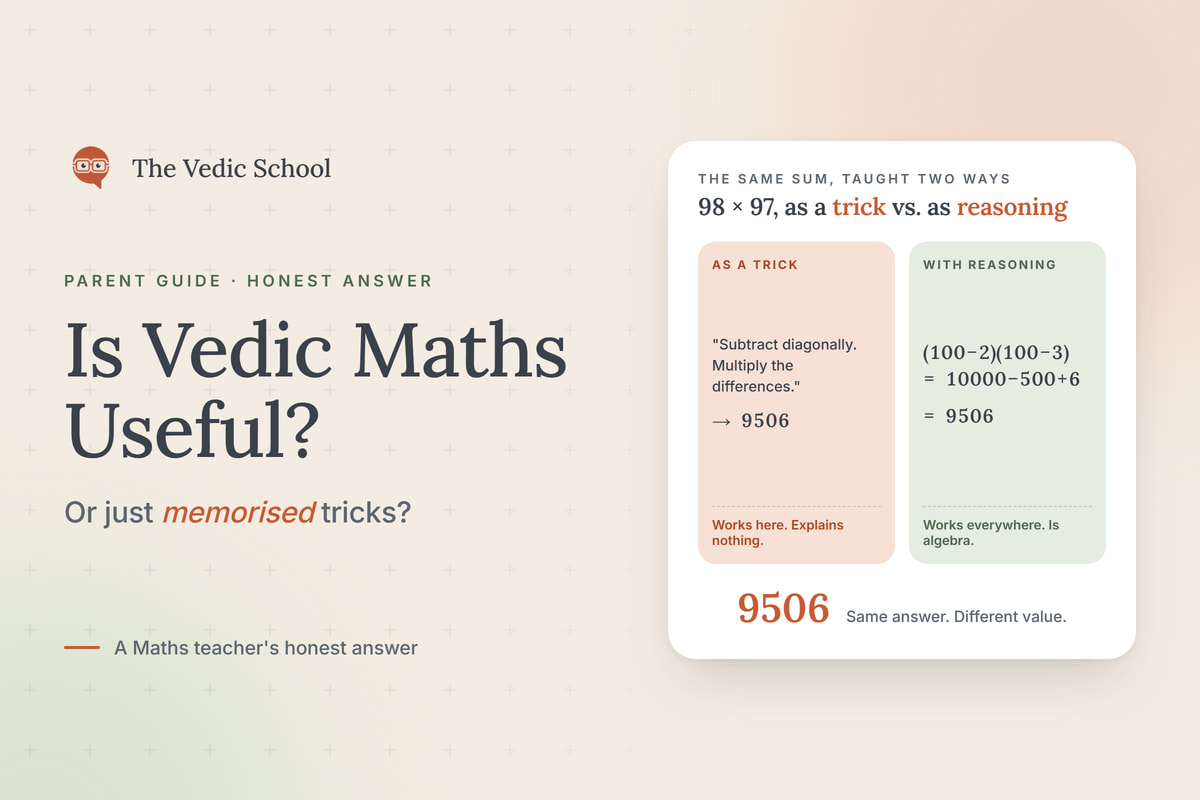
That distinction matters, because it tells you what it can and cannot do. If you want the longer version of that argument, including where the critics are right, read Is Vedic Maths Useful, or Just Tricks?
Where Does Vedic Maths Help in School Exams?
1. Speed on arithmetic-heavy questions
CBSE and ICSE papers from Class 5 to Class 10 are full of computation: fractions, decimals, percentages, ratio, simple and compound interest, area and perimeter, mensuration. A student who can multiply 98 × 97 mentally (Nikhilam sutra, answer 9506) or square 65 in two seconds (Ekadhikena Purvena, answer 4225) saves time on every step. Over a three-hour paper, that adds up to 10 to 15 minutes. That is the time most students say they "didn't have" for the last two questions.
2. Fewer careless errors
Long multiplication has many places to slip. Vedic methods shorten the working, so there are fewer places to go wrong. The digit-sum check (Navashesh) also lets a child verify an answer in seconds without redoing the sum. In our experience, this is the single most useful habit for a student who "knows the method but loses marks".
3. Number sense
Children who practise Vedic maths start seeing relationships between numbers: that 47 × 53 is (50 − 3)(50 + 3), that 125 is 1000 ÷ 8. This is not a trick. It is the number sense that Class 8 algebra quietly assumes you already have.
4. Confidence
This is the one parents underestimate. A child who can beat a calculator on a few sums stops believing they are "bad at maths". That belief change shows up in exam behaviour: attempting the hard question instead of leaving it blank.
Where Vedic Maths Does Not Help?
1. Concepts
Vedic maths will not teach a child why the angle sum of a triangle is 180°, what a linear equation represents, or how to set up a word problem. Those are the parts of the syllabus where most marks are actually lost in the higher classes, and no sutra covers them.
2. Showing working
CBSE and ICSE examiners award step marks. A student who writes "98 × 97 = 9506" with no working may lose those marks in a section that asks for method. The right use is to compute mentally, then write the standard working the teacher expects. A good Vedic maths class teaches children exactly when to do this. A bad one does not, and that is where the "it confused my child" complaints come from.
3. Higher classes
By Class 11 and 12, the paper is about calculus, coordinate geometry, probability and proof. Arithmetic speed still helps in the middle of a long integration, but it is no longer the bottleneck. The sweet spot for Vedic maths is Class 4 to Class 10.
How Vedic Maths Map to the CBSE and ICSE Syllabus?
Here is a rough alignment. The point is that the Vedic maths syllabus should track what the child is doing in school that term, not run as a separate subject. For the official chapter lists, see the CBSE Curriculum 2026-27 and the CISCE syllabus documents.
| School topic (CBSE / ICSE) | Typical class | Vedic technique that applies |
|---|---|---|
| Multiplication and division of large numbers | 4 to 6 | Nikhilam, Urdhva Tiryagbhyam (vertical and crosswise) |
| Squares and square roots | 6 to 8 | Ekadhikena Purvena, Dwandwa Yoga (duplex) |
| Fractions, decimals, percentages | 5 to 8 | Base method, digit-sum checks |
| Simple and compound interest, profit and loss | 7 to 9 | Fast percentage calculation |
| Algebraic identities, factorisation | 8 to 10 | Sutra patterns mirror (a+b)², (a−b)², a²−b² |
| Mensuration, area and volume | 6 to 10 | Fast squaring and multiplication inside formulae |
| Cube roots, quadratic equations | 8 to 10 | Yavadunam, Vilokanam (observation) |
Notice what is missing: geometry proofs, statistics, graphs, word problems. That is deliberate. Those need conceptual teaching, and any programme that claims Vedic maths covers them is overselling.
What a Sensible Programme Looks Like?
If the goal is better school marks, the Vedic maths course should be built around the child's school calendar. In practice that means:
- The technique taught this month matches the chapter in school this month.
- Every technique is practised alongside the standard written method, not instead of it.
- The child learns a two-minute checking routine for the exam paper.
- Progress is measured on school-style questions, not only on speed drills.
This is the approach The Vedic School takes across its Vedic Maths classes and its Curriculum-Aligned Maths classes, and it is why we teach the two together rather than as separate products. The Vedic side builds speed and confidence. The curriculum side makes sure the concepts are actually there.
So, Should Your Child Learn Vedic Maths?
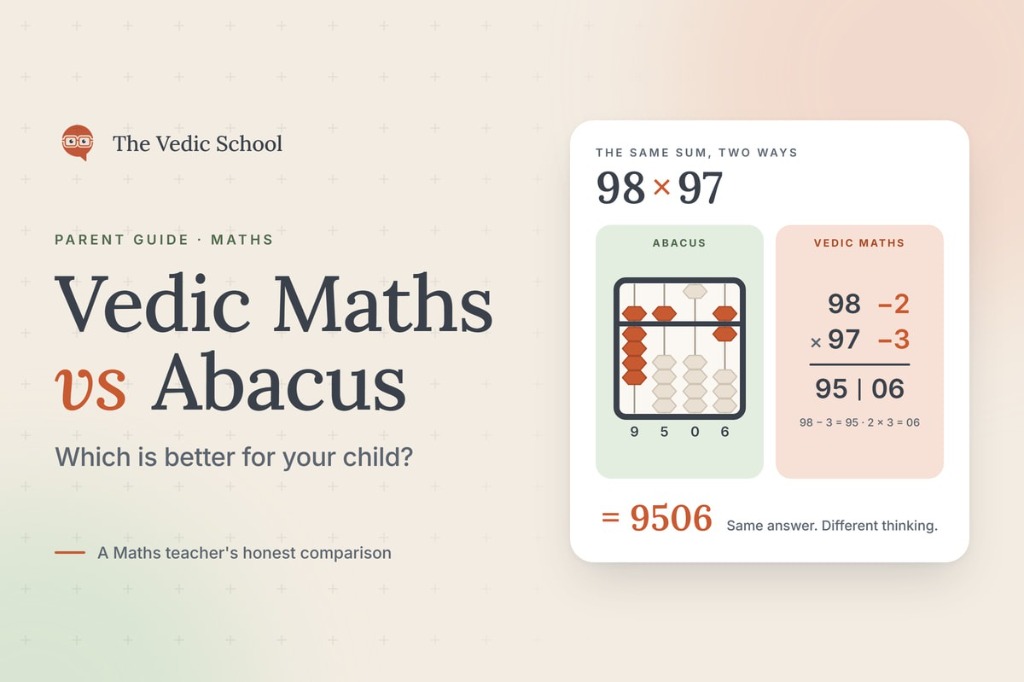
If your child understands maths but loses marks on time and careless mistakes, Vedic maths is one of the highest-return things you can add, especially between Class 4 and Class 10. If you are still weighing it against other options, our comparison of Vedic Maths vs Abacus covers what each one actually trains.
If your child does not understand the concepts, start there. Vedic maths on top of a weak foundation just makes wrong answers faster.
If you are not sure which of the two it is, a single diagnostic session usually makes it obvious. That is where we suggest parents begin. Book a personal assessment and we will tell you honestly what your child needs.
References & Research
Sources
- Cbse Academic — CBSE Curriculum 2026-27 (official)
- Bharati Krishna Tirtha — Vedic Mathematics by Bharati Krishna Tirtha
- CISCE — CISCE (ICSE board, official)
Frequently Asked Questions
Questions Parents Often Ask
Experience Vedic Maths in Action
See how mental maths shortcuts, speed calculation, and number sense rebuild confidence. Join our live parent-child Sunday demo.