_1786009245523-BvnNmDYr.png)
Is Vedic Maths Useful, or Just Tricks? A Teacher Answers
Vedic Maths isn't from the Vedas, and the '10x faster' claims are marketing. But the techniques are real algebra, not tricks, when taught right. A teacher makes the honest case, including where critics are correct.
I teach Vedic Maths every week. Here's what the critics get right, what the marketing gets wrong, and the honest answer to whether it actually helps a child.
By Meenakshi Koul, Founder, The Vedic School
Quick verdict: Yes, Vedic Maths is useful, but only when it's taught to explain why a method works, not just how to do it. Taught as a list of tricks to memorise, it's exactly what the critics say: fast answers with nothing underneath. I teach it the first way. The distinction isn't marketing, it's the entire argument, and I've tried to make the case against my own subject as honestly as the case for it.
TL;DR
Vedic Maths is not from the Vedas. It was published in 1965 by Bharati Krishna Tirtha. Historians have found no trace of its sutras in the actual Vedic texts. This is settled, not controversial.
The techniques themselves are valid maths, not pseudoscience. Every result can be checked with ordinary arithmetic, because the methods are built on real algebraic identities.
The "10x faster" claims are marketing, not research. The actual studies are small, short, and show modest gains, not transformation.
The real risk is memorising the trick without the reason. A child can get the right answer and still not understand what they did, which shows up the moment the numbers don't fit the pattern.
On Reddit, the split is almost exactly this: people who were taught it as isolated tricks call it pointless; people taught the reasoning defend it.
My answer: it's a genuine tool for number sense, not a replacement for understanding, and not a replacement for the school curriculum either.
Is Vedic Maths Useful? The Claims, Checked
| The claim | What critics say | What's actually true |
|---|---|---|
| "It's thousands of years old, from the Vedas" | Historians find no such sutras in the actual Vedic texts | Correct: it was written in 1965. The "Vedic" label is disputed even among Indian mathematicians |
| "Children get 10 to 15 times faster at maths" | Marketing exaggeration, not backed by evidence | The real studies show modest gains in specific tasks, not a multiple across all of maths |
| "It's just a bag of memorised tricks" | A common, fair complaint when it's taught badly | The techniques are mathematically valid, but they become tricks the moment nobody explains why they work |
| "It builds real understanding" | Vendors' marketing claim | True only if it's taught that way. It's a teaching choice, not a property of the method |
| "It replaces school maths" | Sometimes implied by adverts | No. It's a set of calculation methods, not a curriculum |
Key takeaway: Almost every claim about Vedic Maths, for or against, turns out to be true only under specific conditions. The honest answer is conditional, not a flat yes or no.
At The Vedic School, we follow a simple approach:
Understand → Practise → Accelerate
That keeps the focus where it belongs: helping children become confident with numbers, not simply faster at tricks.
I Teach Vedic Maths Every Week. Here's My Honest Answer.
I've taught Maths for more than 15 years, first in India and now online, and "is Vedic Maths actually useful, or is it just tricks?" is a question I get from parents directly, not just something I see argued online. My honest answer is that it can be either, depending entirely on how it's taught, and I built The Vedic School around making sure it's the first one.
[EXPERIENCE: Meenakshi, 2 to 3 sentences. Describe one real moment where a child used a Vedic method correctly but couldn't explain why it worked, or the reverse: a child who struggled with the trick until you showed them the reasoning behind it, and it clicked. Use a real example, not a general statement.
What Is Vedic Maths, Briefly
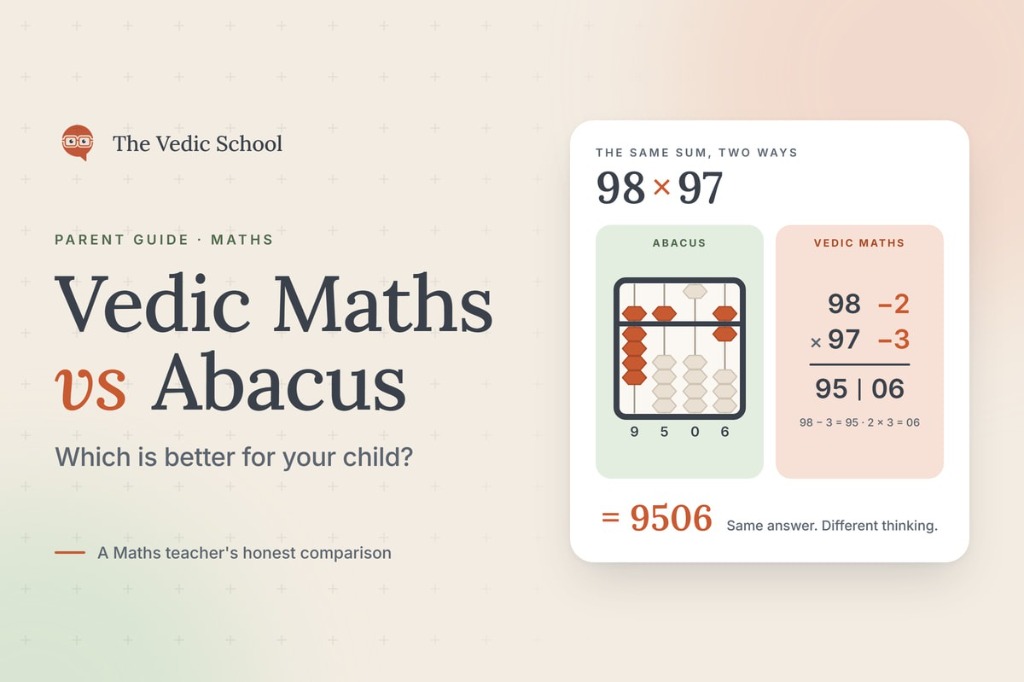
Vedic Maths is a set of calculation methods published in 1965 in Vedic Mathematics by Bharati Krishna Tirtha, organised into 16 short rules called sutras. I've written about where it actually comes from, and how it compares to abacus, in Vedic Maths vs Abacus. The short version for this post: the "ancient" framing is the part that doesn't hold up. The techniques themselves are a separate question, and that's what the rest of this post is about.
Key takeaway: Keep the history question and the usefulness question separate. Conflating them is where a lot of the online arguments go wrong in both directions.
The Case Against: "It's Just Memorised Tricks"
The strongest version of this argument doesn't come from a random comment. It comes from Bhanzu, a well-funded maths platform that deliberately doesn't teach Vedic Maths, and says so on its own site: Vedic shortcuts cover arithmetic, but "word problems, algebra, geometry, reasoning, they need understanding, not tricks." Their argument is that the sutras are real pattern-based shortcuts built on genuine algebra, but memorising them doesn't build the number understanding that maths actually depends on.
I think that's a fair criticism of bad Vedic Maths teaching, and Reddit backs it up. On r/delhiuniversity, a student who'd studied both abstract maths and Vedic Maths put it plainly: the techniques are "very trivial and isn't of much Mathematical value especially the way it's taught without showing why it works the way." Notice what that criticism actually targets: not the maths, the teaching. A longer-running r/india thread, "The Fraud of Vedic Maths", makes a related but different point: arithmetic is a tiny fraction of mathematics, so treating a set of arithmetic shortcuts as a complete system is overselling it.
And the "ancient Vedic" framing genuinely doesn't survive scrutiny. S. G. Dani, a mathematician at IIT Bombay, has shown the sutras aren't found in the Vedas and have "practically nothing in common" with mathematics from the Vedic period. A widely shared r/india thread called "Mythbusting of Vedic Mathematics" links to exactly this kind of academic critique.
Key takeaway: The strongest case against Vedic Maths isn't "the maths is fake." It's "the marketing overclaims the history, and badly taught, the tricks don't build understanding." Both of those are true.
The Case For: What's Actually Useful About Vedic Maths
Start with what even the critics concede: the techniques are real maths. Every Vedic method can be verified with ordinary arithmetic, because it's built on standard algebraic identities. That's not a fringe defence. It's the whole reason Nikhilam multiplication works: 98 × 97 becomes (100 − 2)(100 − 3), which is basic algebra wearing a shortcut's clothes. On r/scienceisdope, a reply to a sceptical post about Vedic Maths made a similar, more practical point: it's genuinely useful for faster calculation, including in entrance exams, and dismissing it outright misses that.
The research is thinner than the marketing but not nothing. A study in middle-school classrooms found improved scores after Vedic Maths instruction (Innovare Journal of Education), and a separate study with Grade 7 students found gains in basic mathematical skills and engagement (RSIS International). Both are small, short studies, not the kind of multi-year randomised trial I'd want before making a strong claim, and I said the same thing about the abacus research in my last post. But "modest positive evidence from small studies" is a real category, and it's different from "no evidence."
Key takeaway: The honest evidence base is: mathematically valid, genuinely useful for calculation speed and exam confidence, with small positive studies behind it, not the "10x faster, proven by science" version the ads sell.
So Which Is It? It Depends on How It's Taught
Here's the same technique, taught two different ways, so the difference isn't abstract.
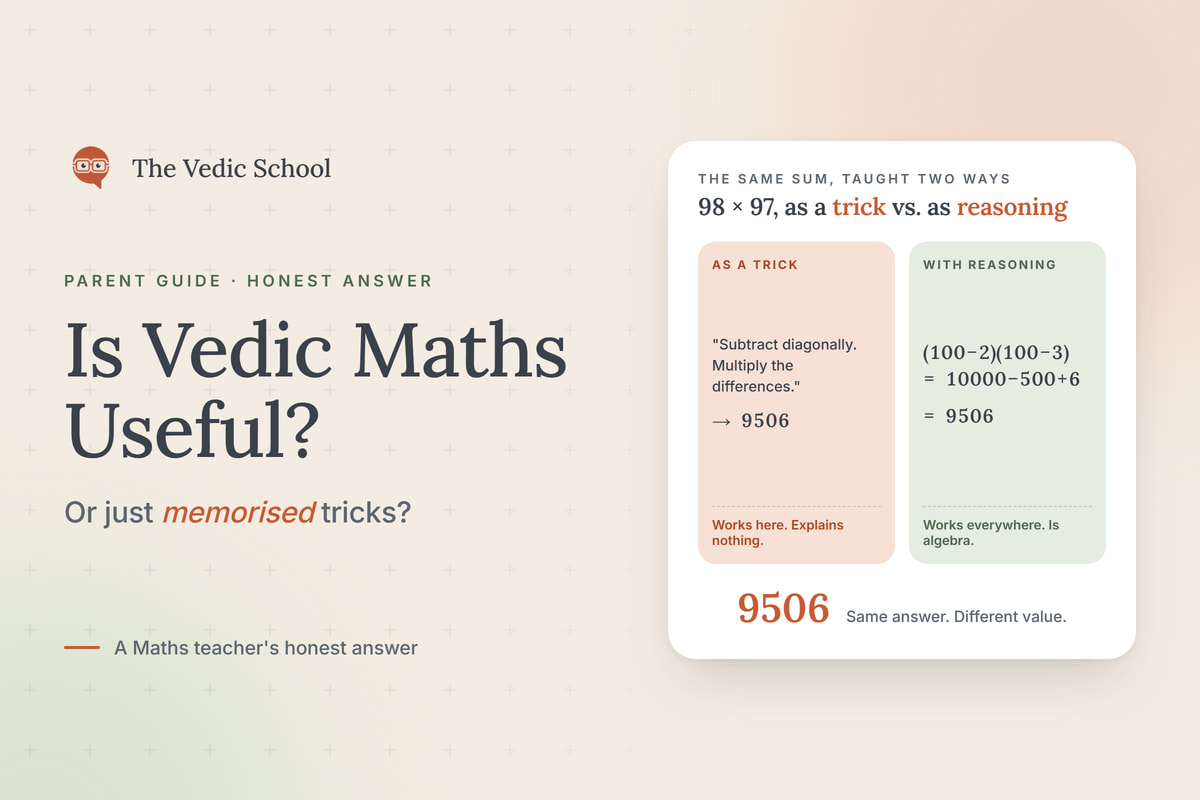
Taught as a trick: "For numbers close to 100, subtract diagonally, then multiply the differences and write them as the last two digits." A child can follow that rule and get 98 × 97 = 9506 without knowing why it works. The moment the numbers aren't close to 100, or a teacher asks them to explain the answer, the method offers nothing.
Taught for understanding: 98 is 100 − 2, and 97 is 100 − 3. So 98 × 97 = (100 − 2)(100 − 3), which expands to 100×100 − 100×3 − 100×2 + (2×3) = 10000 − 500 + 6 = 9506. The "shortcut" is just that expansion, done efficiently. A child who sees this can explain their answer, spot when the shortcut doesn't apply, and use the same algebraic thinking somewhere else entirely.
Same technique. Same right answer. One builds nothing that transfers. The other is algebra, and it transfers everywhere. This is the entire diagnose → rebuild → accelerate method I built The Vedic School around: diagnose what's solid and what's missing, rebuild the gap, and only then accelerate with a Vedic method, because a shortcut on a shaky foundation just moves the gap somewhere less visible.
Key takeaway: "Is Vedic Maths useful" is really "was this technique taught with the reasoning or without it." Same sutra, opposite outcome.
Where the Critics About Vedic Maths Are Right?
To be direct about it:
They're right that it's not from the Vedas. I say this openly on my own Vedic Maths vs Abacus post. The historical claim doesn't hold up, and a business that leans on it is overselling its own subject.
They're right that "10x faster" is marketing, not research. The real studies show real but modest gains, not a multiplier.
They're right that a child can get a right answer with a memorised trick and still not understand the maths underneath it. I see this exact pattern in my own classes: a fast, confident wrong turn the moment a problem doesn't match the memorised pattern.
They're right that arithmetic shortcuts aren't a substitute for the school curriculum, which covers far more than calculation.
Where I'd push back is the conclusion some critics draw from this: that because it's sometimes taught badly, it has no value taught well. That's an argument about teaching quality, not about the maths.
Key takeaway: Nearly every specific criticism of Vedic Maths is correct about how it's often taught. None of them is a reason it can't be taught properly.
What Reddit Says
I looked at Reddit discussion of Vedic Maths across r/math, r/learnmath, r/scienceisdope, r/librandu, r/india, r/delhiuniversity and r/LifeProTips. This is one of the more evenly split topics I've researched: it isn't dominated by one view.
| Reddit thread | What came up | Leaning |
|---|---|---|
| r/math: Pros and cons to Vedic Maths? | A genuine, open question: is it worth learning if it's mostly computational shortcuts | Curious, neutral |
| r/learnmath: What's your thoughts on Vedic maths? | An open discussion thread inviting varied opinions | Mixed |
| r/scienceisdope: What in the holy Grail's World is Vedic Mathematics | A reply pushes back on blanket dismissal: it's genuinely useful for faster calculation and entrance exams | Defensive, practical |
| r/librandu: Honest Question, What the eff is Vedic maths | A reply argues it isn't a sham, just marketed badly, and is a real accumulation of methods over years | Defensive |
| r/india: Mythbusting of Vedic Mathematics | Links to academic critiques of the "Vedic" framing, including material similar to Dani's work | Sceptical |
| r/india: The Fraud of Vedic Maths | Argues arithmetic is a tiny slice of mathematics, so calling it a complete "Vedic" system overclaims | Sceptical |
| r/delhiuniversity: I had taken Vedic Maths 2 | A maths student says the techniques have little mathematical value "especially the way it's taught without showing why it works" | Sceptical, but about teaching quality specifically |
| r/LifeProTips: The magic of Vedic math | A reply agrees the point is making mental arithmetic easier through situational tricks, since there's no single method that scales to everything | Practical, positive |
Two patterns stood out:
The sceptical threads are almost never about the arithmetic being wrong. They're about the "ancient Vedic" framing, or about being taught the trick without the reasoning. That matches exactly what I've argued above.
The defensive replies rarely claim it's magic. They defend it as a genuinely useful, real set of methods, not the "10x faster" marketing version.
Key takeaway: Reddit's actual disagreement isn't "does the maths work." It's "was I taught the reasoning or just the trick," which is the same distinction this whole post is built on.
Conclusion
Is Vedic Maths useful? Yes, when it's taught the way I try to teach it: understand why a method works before you rely on it being fast. Is it an ancient secret that makes children ten times smarter? No, and I'd rather tell you that directly than have you find out from a skeptical Reddit thread after you've already paid for a course. The technique isn't the problem or the solution. The teaching is.
Key takeaway: The question isn't "is Vedic Maths useful." It's "was this child taught to understand it, or just to perform it."
Editor note (delete before publishing): CTA block. Once the /contact booking page is live (tracker task T07), point both buttons at it instead of the programme pages.
See the difference for yourself
The easiest way to know if a class teaches tricks or understanding is to sit in on one.
Vedic Maths: every Sunday I run a free group demo, so you can see exactly how I teach a method, not just watch a child get a fast answer.
Join Sunday's free Vedic Maths demo class →
Curriculum-aligned classes (CBSE, ICSE, IB · Grades 1 to 10): if the bigger worry is school Maths itself, we start with a personal assessment to find out where the gap actually is.
Curious how Vedic Maths compares to abacus? Read Vedic Maths vs Abacus, or see how I teach and why I built The Vedic School.
About the author
Meenakshi Koul is the founder of The Vedic School. She has taught Maths for more than 15 years, first in India and now online to students across time zones, and teaches Vedic Maths and curriculum-aligned classes (CBSE, ICSE and IB) for Grades 1 to 10. Read more about her approach
Sources
Bhanzu, Vedic Maths Tricks: Do They Actually Help? https://bhanzu.com/math/vedic-math-tricks
Bhanzu, Vedic Maths: What it is, Sutras, Methods and Benefits Explained. https://bhanzu.com/math/vedic-maths
Dani, S. G. Myths and reality: On "Vedic mathematics". https://lakshminarayanlenasia.com/articles/MythsandRealityVedicMathematics.pdf
Wikipedia: Vedic Mathematics. https://en.wikipedia.org/wiki/Vedic_Mathematics
Innovare Journal of Education: Effectiveness of Vedic Mathematics in Middle School Education: An Experimental Study. https://journals.innovareacademics.in/index.php/ijoe/article/view/59020
International Journal of Research and Innovation in Social Science: The Effects of Vedic Mathematics on the Basic Mathematical Skills and Engagement of Grade 7 Students. https://rsisinternational.org/journals/ijriss/articles/the-effects-of-vedic-mathematics-on-the-basic-mathematical-skills-and-engagement-of-grade-7-students/
Biyani Group of Colleges, Vedic Maths – Myth or Science? A Critical Analysis. https://www.biyanicolleges.org/vedic-maths-myth-or-science-a-critical-analysis/
Frequently Asked Questions
Questions Parents Often Ask
Experience Vedic Maths in Action
See how mental maths shortcuts, speed calculation, and number sense rebuild confidence. Join our live parent-child Sunday demo.