_1786009245523-BvnNmDYr.png)
Vedic Maths vs Abacus: Which Is Better for Your Child? A Maths Teacher's Honest Comparison
A Maths teacher compares Vedic Maths and abacus: what each trains, the right age, what research and Reddit parents say, and how to choose.
I compared both on what they actually train, what the research shows, and what parents and former abacus kids say on Reddit, including where each one falls short.
By Meenakshi Koul, Founder, The Vedic School
Last updated: 12 September 2026
On this page: Compared · TL;DR · How I compared them · What is abacus? · What is Vedic Maths? · The same sum, two ways · What the research says · Pros and cons · Which to choose · Can a child do both? · Red flags · What Reddit says · Conclusion · FAQs
Quick verdict: Neither is better for every child. Abacus trains very fast arithmetic by picturing beads, and it works best when a child starts young (roughly 5 to 8) and sticks with it for years. Vedic Maths teaches flexible calculation methods that pay off once a child already knows their number facts (roughly 8 and up). If your child is struggling with school Maths, neither is the first fix; the missing foundation is. In the interest of full disclosure: I teach Vedic Maths, not abacus, and I've tried to be fair to both.
TL;DR
Abacus is a bead-based method that becomes a mental abacus. It has the stronger research record for arithmetic speed: children improved over a 3-year trial in India and a 5-year trial in China. A 1-year trial in US schools found no advantage.
Vedic Maths is a set of calculation methods from a 1965 book. It builds flexibility with numbers, but the research on it is small and thin, and historians dispute its link to the Vedas.
Neither has been shown to raise IQ or deliver "whole-brain development". The trials found no change in general intelligence.
Age matters. Abacus suits roughly 5 to 8 year olds who can commit for years. Vedic Maths suits children whose times tables and place value are already secure.
On Reddit, the speed of abacus-trained children is the benefit people describe most. Whether it helps with school Maths later is where opinions split.
Struggling at school? Find and rebuild the gap first. Speed built on a shaky foundation doesn't last.
Vedic Maths vs Abacus, Compared
| Abacus (mental abacus) | Vedic Maths | |
|---|---|---|
| What it is | A counting frame. Children learn to move beads, then to picture them | A set of mental and written calculation methods |
| Where it comes from | Ancient counting tools. Modern classes build on the Japanese soroban | Vedic Mathematics by Bharati Krishna Tirtha, published 1965 |
| How your child calculates | Moves imaginary beads in their head | Chooses a method that suits the numbers |
| Typical starting age | About 5 to 8 | About 8 and up, once number facts are secure |
| What it covers | Mainly addition, subtraction, multiplication and division | Arithmetic, plus some algebra and ways to check answers |
| Equipment | A physical abacus at first | Pen and paper, then mental |
| How long before real gains | Years. The trials that found gains ran 3 to 5 years | Individual methods can be used within a lesson |
| Research evidence | Moderate: randomised trials, mixed results | Limited: small, short studies |
| Biggest risk | Fast answers without understanding | A "bag of tricks" without understanding |
| Best for | Young children who enjoy visual, repetitive practice and want speed | Children who know the basics and need flexibility and confidence |
Key takeaway: Abacus is one reliable procedure practised to high speed. Vedic Maths is a toolkit of methods, and the skill is choosing the right one.
How I Compared Vedic Maths and Abacus
I've taught Maths for more than 15 years, first in India and now online, and "abacus or Vedic Maths?" is one of the questions parents ask me most. I compared them on five things: what your child actually does in their head, whether it builds understanding or only speed, whether it carries into school Maths, what randomised trials show, and what parents say on Reddit.
Disclosure
I teach Vedic Maths, not abacus, so I have a stake in this. I've held both to the same criteria, linked every study, and left out Reddit posts written by class providers.
Key takeaway: A teacher's comparison with a declared bias, built on published trials and real parent discussion rather than class brochures.
What Is Abacus Maths?
Abacus maths teaches children to calculate with a counting frame of beads on rods. Most modern programmes use a version of the Japanese soroban, which has one bead above the bar and four below on each rod. Each rod is a place value (units, tens, hundreds), so children see and feel how numbers are built.
Children start by moving real beads with their fingers. With practice they stop needing the frame and move imagined beads instead. This is called mental abacus (anzan in Japanese), and it is what lets trained children add long lists of numbers at remarkable speed. Programmes usually run in levels over several years. Franchises such as UCMAS and SIP Abacus are well known in India, the UAE and Southeast Asia, and SIP Abacus describes its programme as being for children aged 6 to 12.
Key takeaway: Abacus is arithmetic made visual. A child first moves beads, then pictures them, and the speed comes from years of practice.
What Is Vedic Maths?
Vedic Maths is a collection of calculation methods published in 1965 in Vedic Mathematics by Bharati Krishna Tirtha. The book organises its methods into 16 sutras (short rules, such as "vertically and crosswise") and 13 sub-sutras. Children learn several ways to solve the same problem, and how to pick the quickest one for the numbers in front of them.
A note on the name, because parents ask. Scholars, including the mathematician S. G. Dani of IIT Bombay, have shown that the sutras are not found in the Vedas and that the methods have "practically nothing in common" with the mathematics of the Vedic period. I'm comfortable saying that openly. I don't teach Vedic Maths because it's ancient. I teach it because, taught properly, it helps children look at numbers flexibly instead of following one memorised procedure.
Key takeaway: Vedic Maths is a modern toolkit of calculation methods with a disputed ancient label. Its value is flexibility, not history.
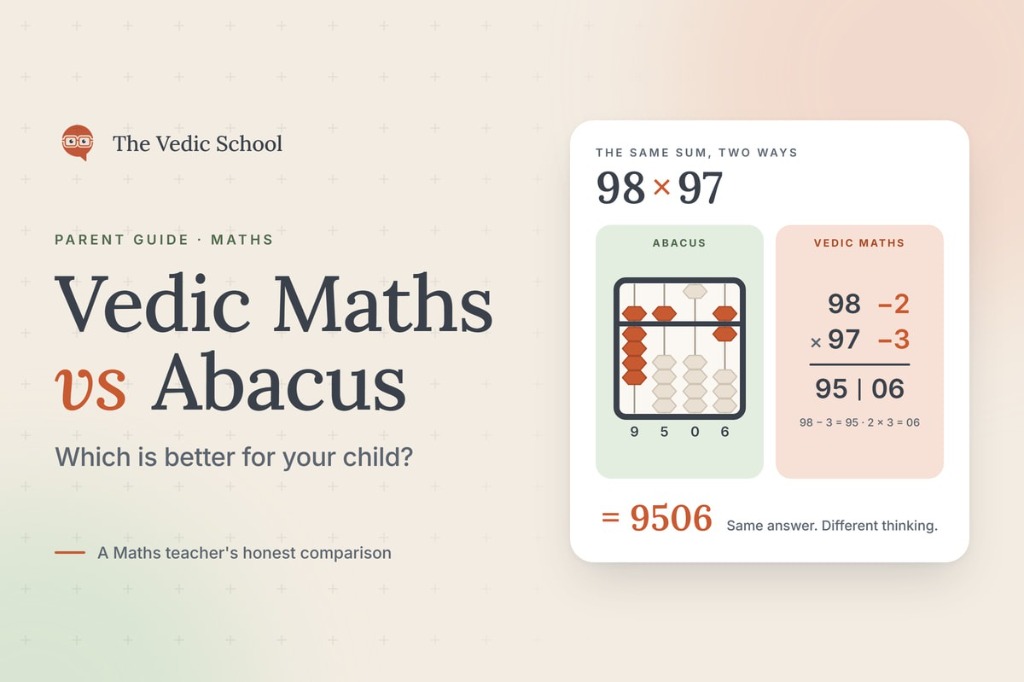
The Same Sum, Two Ways: 98 × 97
This is the clearest way I know to show the difference.
With Vedic Maths (the Nikhilam method, using base 100):
98 is 2 below 100, and 97 is 3 below 100.
Cross-subtract: 98 − 3 = 95 (97 − 2 gives the same). That's the first part of the answer.
Multiply the two differences: 2 × 3 = 06. That's the last two digits.
Answer: 9506.
A child who understands why this works, because 98 × 97 = (100 − 2)(100 − 3), is doing algebra without calling it that.
With abacus: a child sets up the numbers and multiplies digit by digit (9 × 9, 9 × 7, 8 × 9 and 8 × 7), adding each partial product (81, 63, 72 and 56) onto the correct rods. With enough practice, this happens on an imagined abacus in seconds.
The difference shows up with less convenient numbers. Try 47 × 63. The Nikhilam shortcut doesn't help here, so a Vedic Maths learner switches to the general "vertically and crosswise" method: 4 × 6 = 24, then 4 × 3 + 7 × 6 = 54, then 7 × 3 = 21, and carrying gives 2961. The abacus learner does exactly what they did before. One approach rewards choosing well; the other rewards doing one thing very fast.
Key takeaway: Abacus gives one procedure that works on any numbers. Vedic Maths gives a choice of methods, which builds number sense but needs solid basics.
What the Research Says
Abacus: real gains in arithmetic, if the conditions are right
India, 3 years. In a randomised trial with 183 children at a school in Vadodara, Gujarat, children who studied mental abacus for three hours a week outperformed classmates who spent the same time on extra standard Maths. Children who started with stronger spatial working memory benefited most, and the training didn't change basic cognitive abilities (Barner et al., 2016, Child Development; summary from the British Psychological Society).
China, 5 years. A randomised trial with 144 children training two hours a week found better arithmetic and better visuospatial working memory, with no difference in general intelligence on Raven's test (Wang et al., 2019, Journal of Neuroscience).
United States, 1 year. In a classroom trial with about 180 first and second graders, mental abacus students showed no significant advantage in calculation or cognitive abilities. Only about a fifth of the first graders reached proficiency, and the authors point to missing place-value knowledge and the short timeframe (Barner et al., 2018, Journal of Numerical Cognition).
Vedic Maths: encouraging signs, thin evidence
A handful of small studies in Indian schools report better scores or problem-solving after Vedic Maths lessons, for example in middle school and in Grade 7. They are short and small, and mostly published in lower-profile journals. I couldn't find anything comparable to the multi-year randomised trials on mental abacus.
What neither has shown
None of these studies found that either method makes children generally "smarter". When a class promises higher IQ or "whole-brain development", it is going beyond the evidence.
Key takeaway: Abacus has the stronger evidence for arithmetic speed, but only with years of practice and the right starting skills. Vedic Maths has promising but weak evidence. Neither raises IQ.
Pros and Cons
Abacus
| Pros | Cons |
|---|---|
| Concrete and visual, which suits young children | Takes years; the trials that found gains ran 3 to 5 years |
| Builds a strong picture of place value, in fives and tens | Gains depend on spatial working memory, and a one-year trial found none |
| Proven speed gains in long trials | Mostly arithmetic; it doesn't reach fractions, algebra or word problems |
| Clear levels and competitions motivate some children | Children can calculate fast without understanding why |
Vedic Maths
| Pros | Cons |
|---|---|
| Quick wins a child can use in the same lesson | The research is small and thin |
| Several methods for one problem build number sense and flexibility | Special-case tricks confuse children when they're taught as "magic" |
| Works on paper and mentally; some methods extend to algebra and to checking answers | Needs secure times tables and place value first |
| Fits alongside school Maths | The "ancient Vedic" claim is disputed |
Key takeaway: Abacus trades time for speed. Vedic Maths trades a little complexity for flexibility. Both fail when speed replaces understanding.
Which Should Your Child Learn? By Age and Goal
| Your child | My suggestion |
|---|---|
| 4 to 5, just starting numbers | Neither formally yet. Counting, patterns and play-based number sense. |
| 5 to 8, enjoys visual, repetitive practice, and you can commit for years | Abacus can work well, especially once place value has started to click. |
| 8 to 11, knows their times tables but calculates slowly or lacks confidence | Vedic Maths, alongside school Maths. |
| 11 and up, preparing for exams | Vedic methods for speed and for checking answers, with the main focus on understanding the curriculum. |
| Any age, struggling with school Maths | Neither first. Find the gap and rebuild it. |
By goal: for speed and competitions, abacus has the stronger track record. For school confidence and flexible thinking, Vedic Maths alongside curriculum work is the better fit.
Key takeaway: Choose by readiness and goal, not by age alone. A child with gaps needs foundations before either method.
Can Your Child Learn Both?
Yes, but in sequence rather than at the same time. A child who has done abacus already has fast recall and a strong sense of place value, which makes Vedic methods easier to pick up later. What's usually new for them is the idea that there's more than one way to solve a problem, and that choosing is part of the Maths.
Key takeaway: Abacus first and Vedic Maths later can work well. Learning both at once tends to compete for a young child's attention and practice time.
Red Flags When Choosing a Class
Whichever you choose, be wary of:
Promises of higher IQ, "whole-brain development" or photographic memory. The trials don't support them.
Speed drills with no explanation of why a method works.
No link to your child's school curriculum or current topics.
Long upfront commitments before your child has tried a class.
Pushing very young children through levels before place value makes sense.
Key takeaway: A good class explains why its methods work, connects to school Maths, and lets your child try before you commit.
What Reddit Parents and Former Abacus Kids Say
I read Reddit discussions of this across r/india, r/learnmath, r/Kerala, r/AsianParentStories, r/todayilearned and r/librandu. Many "abacus vs Vedic Maths" posts on Reddit are adverts from class providers, so I left those out. Here's what came up in the genuine threads:
| Reddit thread | What came up | Leaning |
|---|---|---|
| r/todayilearned: soroban classes in Japan | After a few years of lessons, children no longer need a physical abacus to calculate fast | Positive on speed |
| r/learnmath: Is abacus really worth it for kids? | A poster's colleague enrolled their children expecting abacus to help with competitive and grammar-school exams; the poster asks whether it's really worth it | Questioning |
| r/learnmath: Thoughts on using an abacus for kids? | The abacus helps young children see how numbers move, through groups of five and ten | Positive on number sense |
| r/learnmath: Is learning the abacus to improve mental math feasible? | Learners discuss moving from a physical abacus to a mental one for fast calculation | Curious, positive |
| r/AsianParentStories: Why do Asian parents put kids in abacus? | A commenter recalls a compulsory weekly abacus class at primary school in Singapore in the early 2000s; the thread asks whether it has any lasting benefit | Mixed |
| r/Kerala: Abacus kids who are now adults, how is it helping you now? | One parent says online abacus classes helped her daughter lose her fear of Maths (the comment names a specific provider) | Positive, one parent |
| r/india: People who learned abacus at school, how does it help you? | One reply lists memory and concentration benefits for abacus and Vedic Maths, but reads more like a class brochure than lived experience | Positive, unverified |
| r/librandu: What is Vedic maths, honestly? | A sceptic argues that neither abacus nor Vedic tricks help much, and that plain working is sometimes faster | Sceptical |
Three patterns stood out:
Speed is the benefit people describe most. The soroban and mental-abacus threads are about how fast trained children calculate.
The real question is transfer. Parents want to know whether that speed helps with school Maths, exams and confidence. The answers are anecdotal and split.
The positive parent stories are about confidence. The clearest example is the r/Kerala parent who describes her daughter losing her fear of Maths.
That matches what I see in class. Confidence changes how a child approaches a problem, but it has to rest on real understanding to last.
Key takeaway: On Reddit the speed isn't really disputed. The debate is over whether it carries into school Maths, and the positive stories are mostly about confidence.
Conclusion
Abacus and Vedic Maths answer different questions. Abacus asks, "How fast can this child calculate?", and with years of practice it often delivers. Vedic Maths asks, "How flexibly can this child think about numbers?", and it suits children who already have the basics. If your child is struggling, the better question is where their understanding broke down, and that's where I always start.
Key takeaway: Choose abacus for early speed if you can commit for years, Vedic Maths for flexibility once the basics are secure, and neither until the foundations are in place.
Not sure where your child should start?
Let's begin by understanding where they are today. Choose the path that fits your child:
Vedic Maths: build fluency and confidence with numbers. Every Sunday I run a free group demo, so your child can experience the method in a real class before you decide anything.
Join Sunday's free Vedic Maths demo class →
Curriculum-aligned classes (CBSE, ICSE, IB · Grades 1 to 10): make that confidence show up in schoolwork. We start with a personal assessment to find the gaps that are getting in the way.
Want to know more first? Read how I teach and why I built The Vedic School, or see how the two programmes compare.
About the author
Meenakshi Koul is the founder of The Vedic School. She has taught Maths for more than 15 years, first in India and now online to students across time zones, and teaches Vedic Maths and curriculum-aligned classes (CBSE, ICSE and IB) for Grades 1 to 10. Read more about her approach
Sources
Barner, D. et al. (2016). Learning mathematics in a visuospatial format: A randomized, controlled trial of mental abacus instruction. Child Development, 87(4). https://academic.oup.com/chidev/article/87/4/1146/8258418
British Psychological Society, Research Digest: Teaching children the ancient "mental abacus" technique boosted their maths abilities. https://www.bps.org.uk/research-digest/teaching-children-ancient-mental-abacus-technique-boosted-their-maths-abilities
Barner, D. et al. (2018). A one-year classroom-randomized trial of mental abacus instruction for first- and second-grade students. Journal of Numerical Cognition. https://jnc.psychopen.eu/index.php/jnc/article/download/5761/5761.html?inline=1
Wang et al. (2019). Training on abacus-based mental calculation enhances visuospatial working memory in children. Journal of Neuroscience, 39(33). https://pmc.ncbi.nlm.nih.gov/articles/PMC6697396/
Dani, S. G. Myths and reality: On "Vedic mathematics". https://lakshminarayanlenasia.com/articles/MythsandRealityVedicMathematics.pdf
Wikipedia: Vedic Mathematics. https://en.wikipedia.org/wiki/Vedic_Mathematics
Innovare Journal of Education: Effectiveness of Vedic Mathematics in Middle School Education: An Experimental Study. https://journals.innovareacademics.in/index.php/ijoe/article/view/59020
International Journal of Research and Innovation in Social Science: The Effects of Vedic Mathematics on the Basic Mathematical Skills and Engagement of Grade 7 Students. https://rsisinternational.org/journals/ijriss/articles/the-effects-of-vedic-mathematics-on-the-basic-mathematical-skills-and-engagement-of-grade-7-students/
Gulf News: Launch of SIP Abacus in UAE (programme for ages 6 to 12). https://gulfnews.com/business/corporate-news/launch-of-sip-abacus-in-uae-empowering-children-worldwide-to-face-future-challenges-with-confidence-1.1686134174124
Frequently Asked Questions
Questions Parents Often Ask
Experience Vedic Maths in Action
See how mental maths shortcuts, speed calculation, and number sense rebuild confidence. Join our live parent-child Sunday demo.